

Safety challenges vary significantly depending on the working environment. On construction sites, where machines frequently travel in dynamic and unpredictable surroundings, protecting operators and pedestrians is the top priority. In sensitive environments such as aircraft manufacturing facilities, maintenance hangars, and airports, the stakes are different: even minor contact between a machine and a high-value asset can result in costly damage, operational disruption, and prolonged downtime.
To address these distinct challenges, Haulotte has developed two intelligent assistance solutions designed to support safer operations in different contexts. The Drive Assist Solution helps protect people by enhancing operator awareness during all phases of machine travel, while Obstacle Detection Assist (ODA) helps protect high-value assets and infrastructure by preventing unintended contact during work at height. Maxime Jalon, Project Manager, and Laurent Lepoutre, Innovation Project Manager at Haulotte, explain how these new technologies help operators work more safely and efficiently while complementing existing safety systems.
Drive Assist Solution: helping protect people during machine travel
The Drive Assist Solution combines three technologies designed to enhance operator awareness and reduce risks associated with machine travel:

Pedestrian Detection Assist
Pedestrian Detection Assist relies on a smart onboard camera powered by artificial intelligence to identify pedestrians around the machine, even in low-light conditions.
Learn more here
User Drive Assist
UDA acts as an educational aid. The system warns the operator when acceleration or speed becomes inappropriate for the terrain, which can cause a "catapult" effect when driving while standing in the basket.
Download the datasheet here
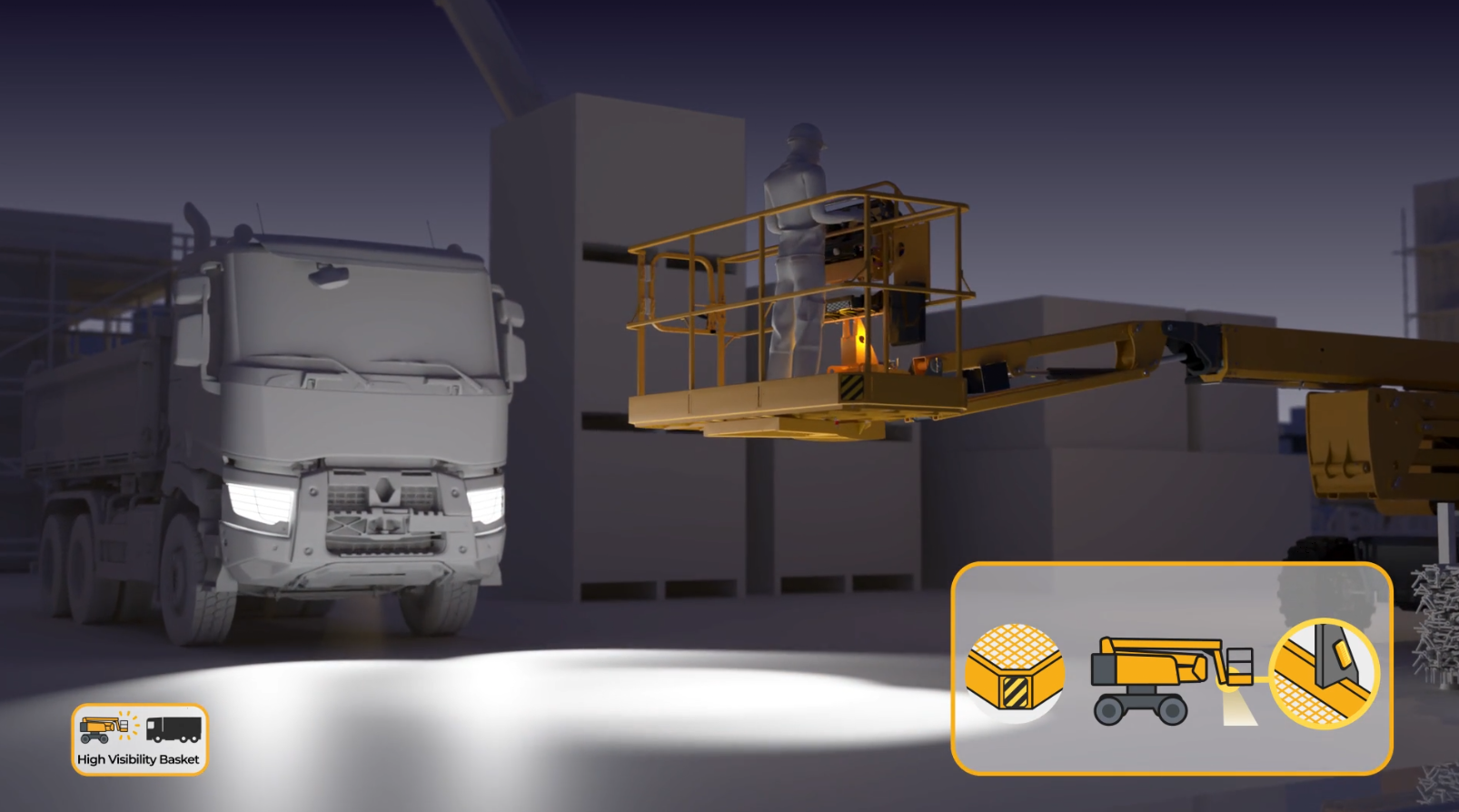
High Visibility Basket
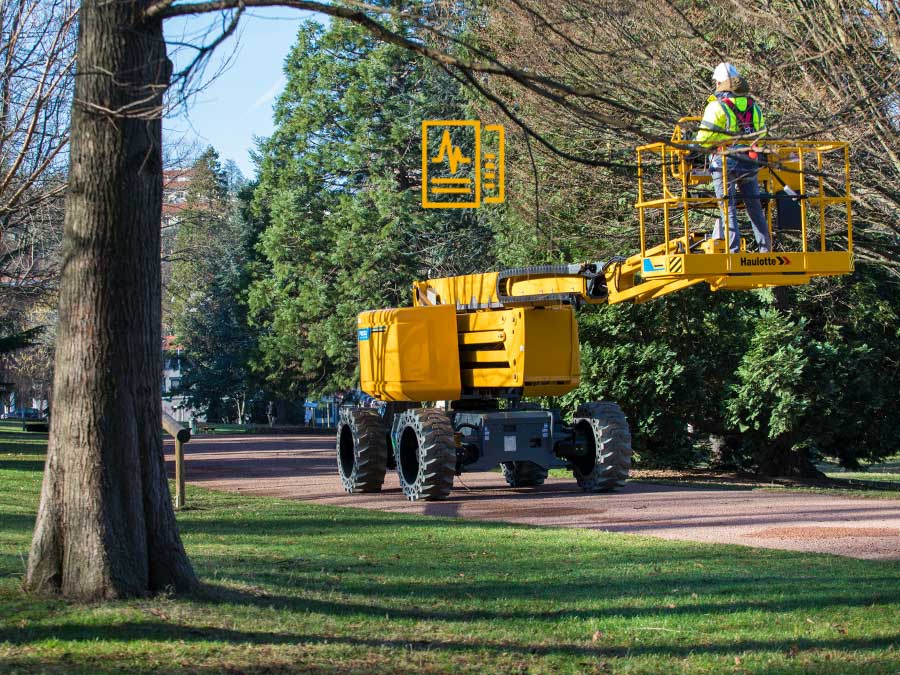
This option increases the visibility of the basket in urban contexts or during operations at dawn and late at night. It draws attention to the most exposed part of the basket during the most critical phases of approach.
Learn more on this
Pedestrian Detection Assist: enhancing awareness around the machine
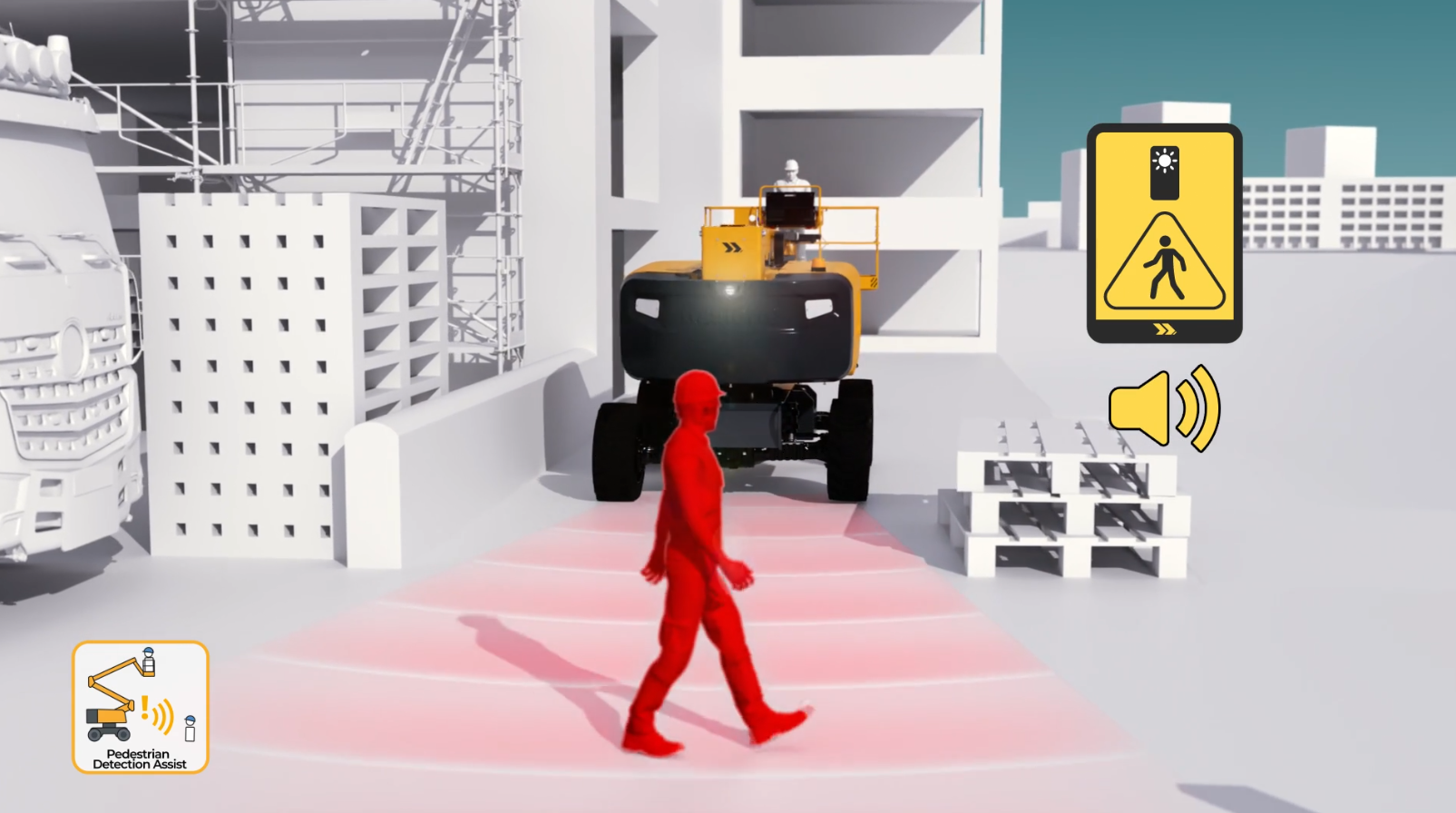
Pedestrian Detection Assist relies on a smart onboard camera powered by artificial intelligence to identify pedestrians around the machine, even in low-light conditions.
By focusing specifically on pedestrian detection rather than every surrounding object, the system delivers relevant alerts while minimizing unnecessary notifications in busy work environments. Visual and audible warnings help operators stay aware of nearby people, particularly during travel and approach phases where visibility may be reduced.
"Detecting everything around the machine would cause constant false alarms on a construction site. Focusing on pedestrians makes the assistance relevant and acceptable to users," explains Laurent Lepoutre.
By focusing specifically on pedestrian detection rather than every surrounding object, the system delivers relevant alerts while minimizing unnecessary notifications in busy work environments. Visual and audible warnings help operators stay aware of nearby people, particularly during travel and approach phases where visibility may be reduced.
"Detecting everything around the machine would cause constant false alarms on a construction site. Focusing on pedestrians makes the assistance relevant and acceptable to users," explains Laurent Lepoutre.
User Drive Assist (UDA): reinforcing safer driving behavior
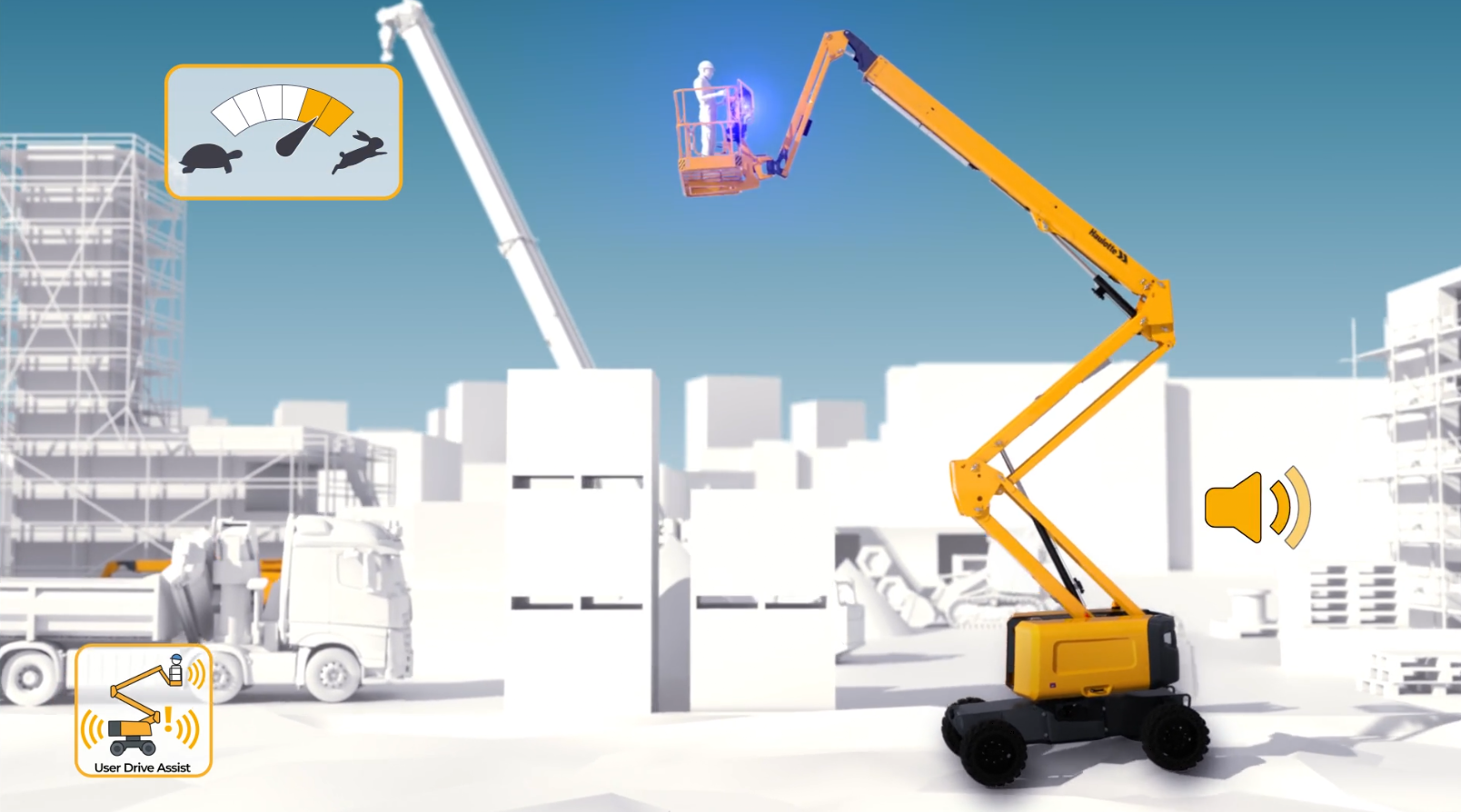
UDA acts as an educational aid. The system warns the operator when acceleration or speed becomes inappropriate for the terrain, which can cause a "catapult" effect when driving while standing in the basket. The aim is not to block the machine, but to reinforce risk perception and encourage drivers to adapt their driving. Events can be tracked to enable HSE teams to measure the impact of preventive actions over time.
"Safety cannot rely exclusively on hard limits. With the UDA, we reinforce risk perception: the machine does not impose, it warns. We can also track changes in behavior after awareness campaigns," says Laurent Lepoutre. This approach helps keep operators actively aware of risk rather than relying solely on automated safety systems.
"Safety cannot rely exclusively on hard limits. With the UDA, we reinforce risk perception: the machine does not impose, it warns. We can also track changes in behavior after awareness campaigns," says Laurent Lepoutre. This approach helps keep operators actively aware of risk rather than relying solely on automated safety systems.
High Visibility Basket: see and be seen in busy environments
This option increases the visibility of the basket in urban contexts or during operations at dawn and late at night. It draws attention to the most exposed part of the basket during the most critical phases of loading, unloading, and approach, where the risk of collision is highest. In the same spirit of user comfort for operators, this function is automatically deactivated when elevated to limit visual fatigue when working at height and is automatically reactivated when returning to approach or loading situations, which are most exposed to the risk of collisions between vehicles.
Obstacle Detection Assist (ODA): protecting high-value assets
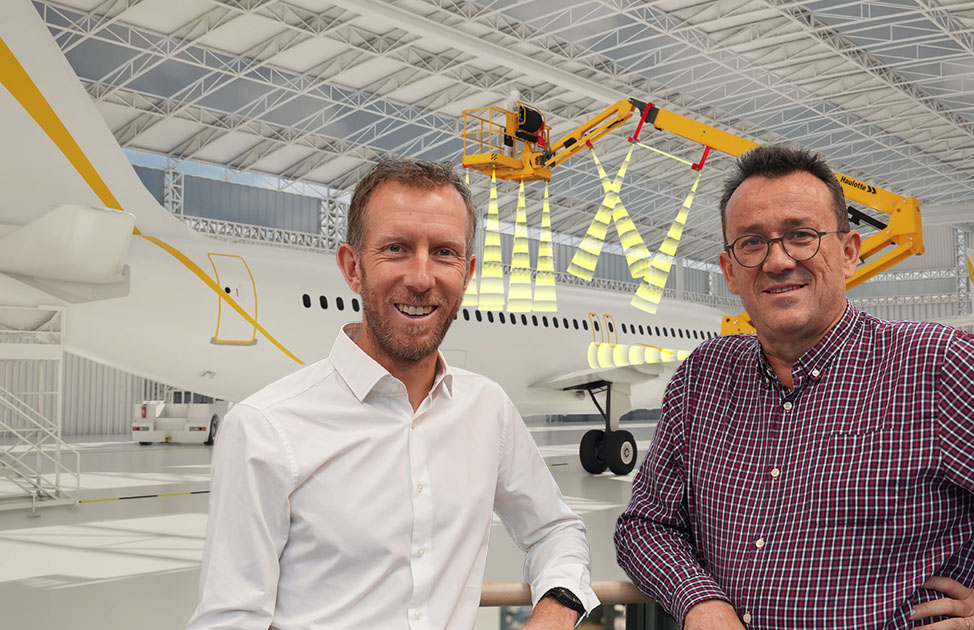
In aircraft manufacturing and maintenance environments, even minor contact between a machine and an aircraft can lead to costly inspections or repairs, operational disruption and extended aircraft downtime.
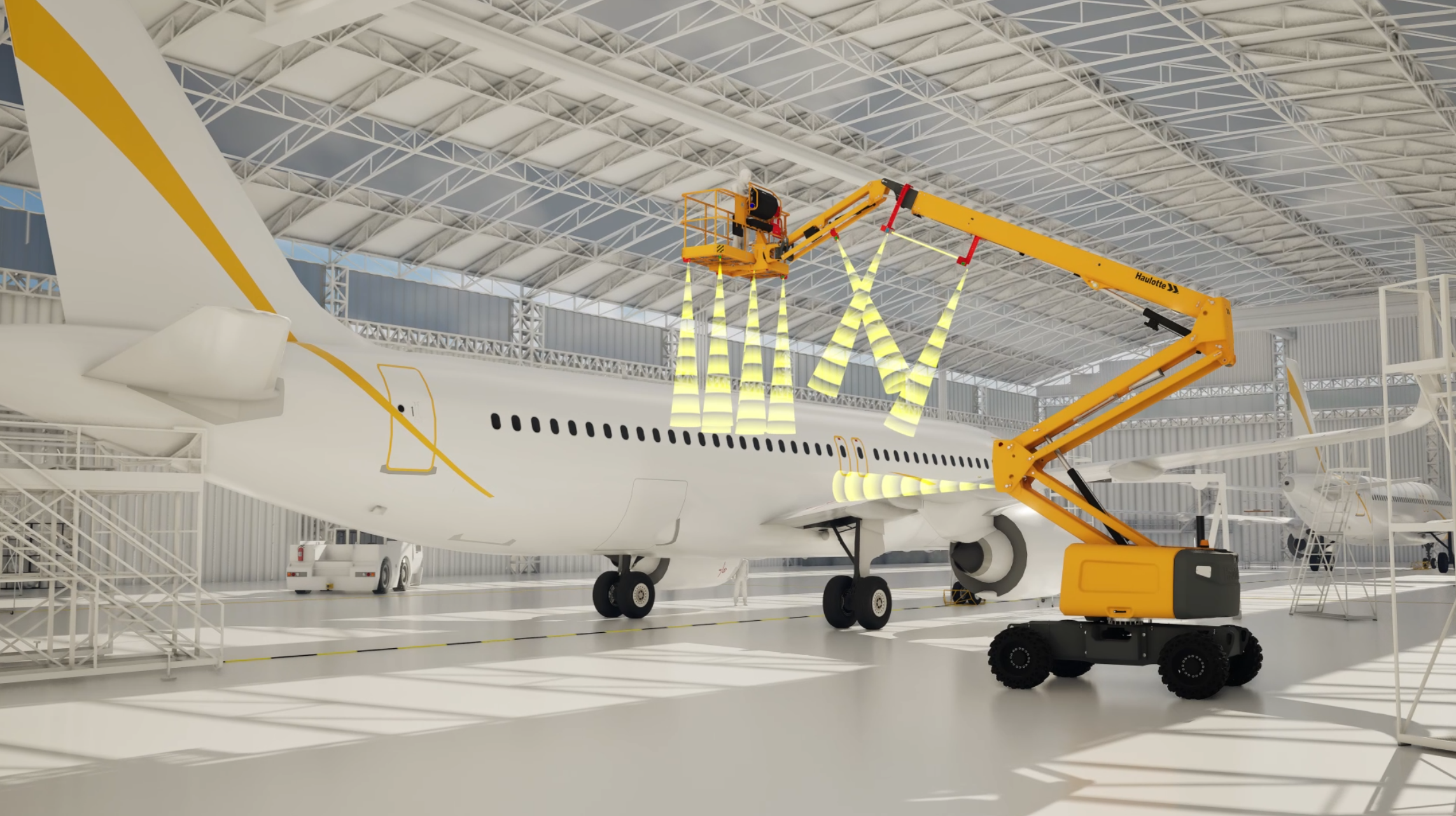
Designed for sensitive sites (aircraft manufacturers and maintenance facilities, airports), ODA aims to prevent the basket from coming into contact with high-value assets such as wings or fuselages.
Ultrasonic and photoelectric sensors positioned in key areas detect when an object is approaching. A visual and audible alert first warns the operator. When the distance becomes critical, approach movements are cut off, while movement away from the object remains possible. The operator can manually reactivate movements if the situation warrants it.

Maxime Jalon on ODA
"The goal is to prevent the basket from touching the aircraft without unnecessarily hindering the work: we only cut off movements that bring it closer, we allow it to move away, and we allow manual resumption when it is safe to do so," explains Maxime Jalon.
Tested directly in airport areas, under real-life conditions, the solution required fine-tuning of the warning and stop distances as well as precise positioning of the sensors. "Setting up a sensor to stop a machine is not the hardest part. The real challenge is where to place the sensors and at what distances to intervene in order to match actual usage," adds Maxime Jalon.
Tested directly in airport areas, under real-life conditions, the solution required fine-tuning of the warning and stop distances as well as precise positioning of the sensors. "Setting up a sensor to stop a machine is not the hardest part. The real challenge is where to place the sensors and at what distances to intervene in order to match actual usage," adds Maxime Jalon.
Different risks. Tailored assistance.
Although both solutions rely on intelligent assistance technologies, they address fundamentally different risk scenarios.
The Drive Assist Solution is designed for dynamic environments such as construction sites, where the priority is reducing risks to people. Through pedestrian detection, driving assistance, and enhanced visibility, it helps operators remain aware of their surroundings and reinforces risk awareness throughout machine travel.
The Drive Assist Solution is designed for dynamic environments such as construction sites, where the priority is reducing risks to people. Through pedestrian detection, driving assistance, and enhanced visibility, it helps operators remain aware of their surroundings and reinforces risk awareness throughout machine travel.
Conversely, ODA addresses a different type of risk in more controlled environments such as aeronautics, combining operator warnings with automatic intervention when proximity becomes critical.
"In aeronautics, the two approaches are truly complementary: we support safer ground approach phases with pedestrian detection, then help protect the aircraft during work with ODA," summarizes Maxime Jalon.
Haulotte plans to gradually roll out the Drive Assist Solution package across its entire articulated and telescopic boom ranges in the coming months. ODA remains a specific application, currently available on models dedicated to the aeronautics industry, including the HA20 E PRO, SIGMA 16 PRO and STAR 10 with targeted extensions studied on a case-by-case basis according to requirements.
Supporting safer operations across every environment
Whether the objective is to protect people on construction sites or to help prevent damage to high-value assets in sensitive industrial environments, intelligent assistance technologies are becoming an increasingly valuable partner for MEWP operators.
For construction applications, Drive Assist Solution enhances preventive safety during travel and approach phases while providing valuable insights for HSE managers. For aeronautical applications, ODA helps reduce the risk of costly damage to high-value assets through a combination of alerts, selective movement cut-off, and controlled operator intervention.
For construction applications, Drive Assist Solution enhances preventive safety during travel and approach phases while providing valuable insights for HSE managers. For aeronautical applications, ODA helps reduce the risk of costly damage to high-value assets through a combination of alerts, selective movement cut-off, and controlled operator intervention.
Together, these solutions can be adapted to specific operational requirements, helping ensure they remain effective, practical, and widely accepted by users in the field.
.jpeg)